© 2022-2026, Tender Grid, All rights reserved.

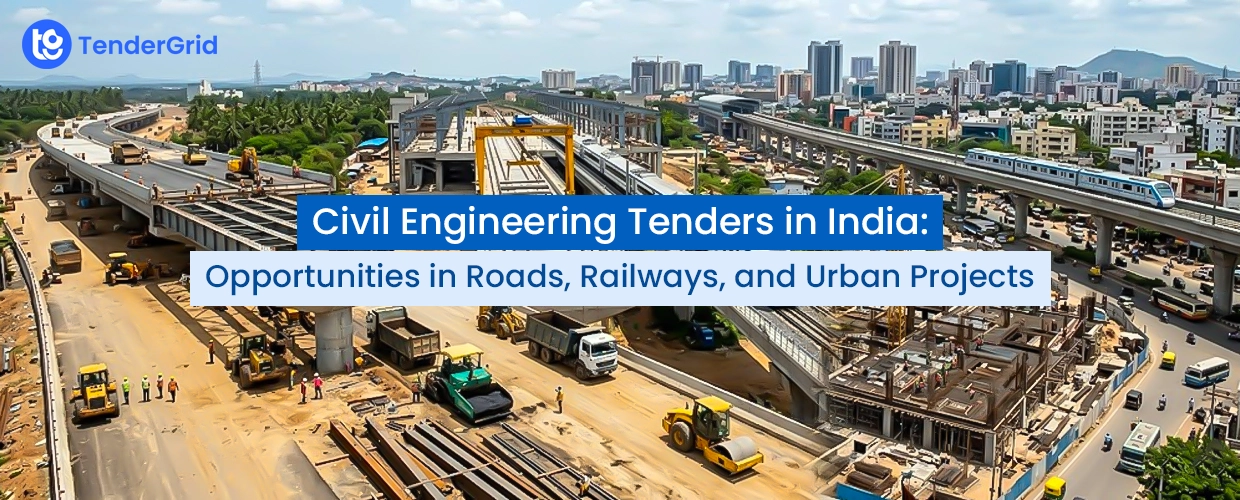
In India, civil engineering projects have become a lifeline for industrial as well as infrastructure development.
Whether roads, railways, or urban development, the development is evident across both urban and rural areas. Most of this development is a direct result of programs like Bharatmala, Smart Cities Mission, Gati Shakti, dedicated freight corridors, etc.
Additionally, concerns like rising urban migration and logistics demand are further pushing the demand for civil engineering tenders in India.
As the government is looking to stretch highways across economic corridors, modernize railway networks, and exponentially expand cities, the number of civil engineering tenders, including road and highway tenders, railway construction tenders, and urban development tenders, is also expected to grow immensely.
This blog provides comprehensive information on the civil engineering tenders in India along with other related information, such as upcoming opportunities in roads, railways, and urban projects, types of civil engineering tenders, their role in India’s infrastructure development, and much more.
Civil engineering tenders are important in India’s infrastructure growth because they provide a structured, competitive, and transparent process to transform the government plans and public funds into real roads, rail lines, bridges, and urban systems.
For instance, road and highway tenders help in logistics expansion, such as the development of expressways.
Railways construction tenders help in freight and mobility upgrades, such as the development of tracks, upgradation of stations, and electrification of railway systems.
Urban development tenders cover urbanization projects associated with water supply, housing, and metro projects.
Apart from these, they also:
Without these civil engineering tenders, large-scale execution of infrastructure and construction projects at this pace simply wouldn’t happen.
The market for civil engineering tenders in India today is a huge one with further scope for exponential growth in the upcoming years. This is because of factors like the infrastructure spending exceeding ₹12.2 lakh crore annually, a construction industry worth over $740 billion in 2025, and a pipeline of projects that continues to expand across roads, railways, and urban development.
The following projects have significantly contributed to this huge market size:
Apart from these, the government is also planning to invest around $1.4 trillion under the National Infrastructure Pipeline (NIP), making the market bigger and full of opportunities.
Civil engineering tenders in India cover the development, maintenance, and expansion of roads, railways, urban infrastructure, water systems, and specialized works like bridges and tunnels. Each of these tender types offers various growth opportunities for both MSMEs and large enterprises. Here are some of the leading types of tenders:
These types of tenders cover the construction, maintenance, and expansion of roads and expressways. Projects, such as EPC highway construction, road widening, road maintenance, resurfacing, expressway development, etc., are executed through these tenders. Authorities like NHAI, State PWDs, and MoRTH release such tenders.
These are among the most technically demanding segments that improve the speed, capacity, and efficiency of the railway systems. Tenders for track infrastructure, electrification, station redevelopment, and freight corridor projects are released under these. Indian railways, DFCCIL, and Metro Rail Corporations typically issue these tenders.
Urban development tenders focus on the development of urban infrastructure. Projects associated with water supply, sewage systems, waste management, housing, metro projects, etc., are executed through urban development tenders. These tender types are released by municipal corporations, development authorities, smart city SPVs, etc.
At present, water is becoming a central infrastructure priority, making these types of tenders great for developing large-scale pipeline networks and irrigation systems. Projects associated with water pipelines, treatment plants, canals, dams, etc., are completed through these. These tenders support both urban consumption and agricultural needs.
Building construction tenders are issued by CPWD, state construction boards, housing authorities, etc., to build and maintain government, institutional, and residential structures. Projects associated with building construction, residential housing schemes, renovation, retrofitting, turnkey building construction, etc., are carried out through these tenders.
Apart from the above-mentioned ones, civil engineering tenders also cover projects associated with bridges, flyovers, tunnels, specialized infrastructure, industrial corridor development, defense infrastructure, etc.
At present, various railways construction tenders are released by several authorities to carry out works related to new broad-gauge (BG) line construction, high-value track doubling, major infrastructure upgrades, etc. Some of the leading active tenders are as follows:
In 2026, businesses can benefit from the following road and highway tenders:
Various urban development works have been carried out by the government authorities across different states of India. The following are the active ones:
At the present time, the Indian government is rapidly developing and expanding its infrastructure projects at scale. As a result, civil engineering tenders are no longer just growth opportunities; rather, they act as the backbone behind this immense development.
As the government plans to cut travel time, strengthen freight movements, enhance passenger capacity, and expand the logistics network, the number of road tenders and highway tenders, railways construction tenders, and urban development tenders is about to explode.
New players looking to enter this space should consider using Tender Grid to track all these civil engineering tenders in one place.