© 2022-2026, Tender Grid, All rights reserved.

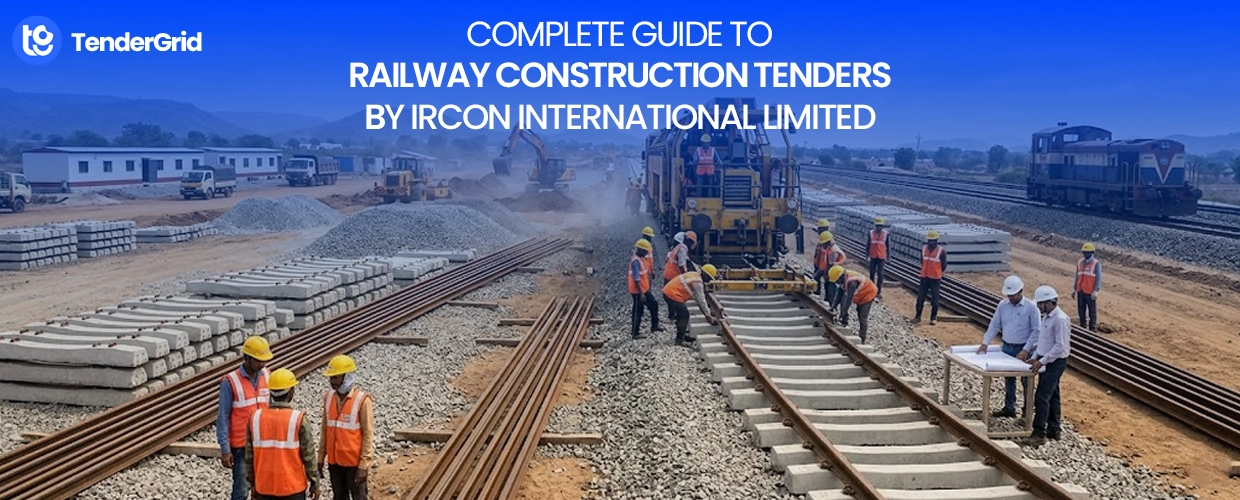
The Indian railways sector plays a major role in India’s economic growth. This is because it enables faster connectivity for logistics and population movements.
From new freight corridors and high-speed rail projects to station upgrades, capacity expansion, and electrification, the government is committed to developing robust railway infrastructure that can constantly support the nation’s growth without any mobility issues.
Indian Railway Construction International Limited is one of the leading public sector enterprises that is helping the government achieve this vision. It provides a steady flow of IRCON tenders and IRCON eTenders, especially in the railway construction tenders space.
For contractors, consultants, and infrastructure firms, these are not just contracts; they offer high-value and long-term opportunities.
This blog offers a complete guide to railway construction tenders by IRCON International Limited. Businesses looking to invest in these government tenders could tremendously benefit from the comprehensive information provided in this blog.
In India’s railway expansion, IRCON acts as a specialized execution arm for delivering complex, high-value rail infrastructure and construction projects faster, at scale, and often in challenging environments where standard contractors struggle.
At times, when the Indian government is focusing more on the execution than the announcement, IRCON has become the go-to agency. Through IRCON projects, the company carries out the execution activities for the large-scale railway construction projects that demand precision and speed.
At the present time, the Indian government is working on the following various large-scale initiatives:
To effectively execute and deliver these initiatives, the government needs a reliable execution partner that has the optimal capabilities to drive India’s railway expansion. IRCON fills this gap by bringing:
As a result, one can say that IRCON tenders significantly drive India’s railway expansion to meet the growing demand.
IRCON International Limited tenders follow a structured eProcurement process where contracts are awarded to vendors based on strict eligibility criteria, designed to filter serious bidders from casual ones.
Here’s how it actually works:
The process starts with IRCON publishing a tender on its official portal. Then, the interested bidders need to identify the relevant tenders, go through the tender documents carefully, and accordingly submit the technical and financial bids.
After bids are submitted, IRCON manually evaluates each bid. Vendors with poorly prepared technical bids are rejected instantly. Financial bids of only those vendors are evaluated who provided proper technical bids. After evaluating both bids, IRCON awards the tender to the most reliable vendor having optimal pricing and the required technical expertise to timely deliver the project.
IRCON eTenders cover a wide spectrum of railway and infrastructure works. Each tender type targets a different layer of railway infrastructure, designed to address specific project requirements within the railway ecosystem. Some of these different types of IRCON eTenders are as follows:
Civil construction tenders cover broad and execution-heavy works, such as earthwork excavation, cutting, filling, compaction, formation of railway embankments, construction of station buildings, road works within railway premises, etc.
These types of tenders include works associated with track laying and linking, ballast supply, sleeper laying, rail unloading, flash butt welding, track alignment, points and crossings installation, and many more.
These tenders are issued for structural connectivity. Under these types of railway construction tenders, projects associated with the construction of rail overbridges, piling and foundation works, substructure works, superstructure launching, prestressed concrete girder casting, steel girder fabrication, bearing installation, and load testing are executed.
These tenders cover activities such as overhead equipment installation, mast erection, traction substation setup, SCADA system integration, cable laying, earthing systems, testing, and commissioning of electrified sections.
Signaling and telecommunication tenders in railway infrastructure are released to carry out activities related to electronic interlocking system installation, automatic block signaling, track circuiting, axle counters, installation of signals, optical fiber cable laying, telecom tower setup, data communication systems integration, and many more. These tenders are critical for safe train operations.
Projects associated with tunnel excavation, rock bolting, ventilation, drainage systems, waterproofing, portal construction, slope stabilization, installation of safety systems, etc., are executed through tunnel construction tenders.
IRCON floats these types of tenders for carrying out works related to track renewal, replacement of worn-out components, bridge repair, electrification system upgrades, signaling system modernization, routine inspection, and maintenance services.
In 2026, the following IRCON tenders are currently active:
To effectively apply for IRCON railway construction tenders, businesses should focus on the following steps:
It is the first step in which vendors are required to register on official government eProcurement portals, such as GeM and CPPP. They need to provide the relevant business details during the registration process to avoid any problems.
After registration, the vendors need to look out for the right tenders that are relevant to their business and its offerings. They should match the tender scope with their core expertise, check project size vs. their financial capacity, review location, and assess execution feasibility to identify the most relevant IRCON tenders.
Once the tender is identified, vendors need to properly study all the tender documents. They should determine the scope of work, eligibility criteria, technical specifications, payment terms, etc.
When preparing the technical bid, vendors need to ensure that they are providing the past work experience proofs, required financial statements, equipment details, and other critical information that shows their competence.
After the technical bid, vendors need to prepare the financial bids in which they are required to fill every line item carefully, avoid any calculation errors, and consider the actual execution costs instead of making assumptions. This is because low pricing alone won’t save a weak bid, so businesses need to provide smart pricing that perfectly suits the project execution timeline and budget.
Once prepared, vendors should upload the bids as early as possible on the official eProcurement portals where the tenders are published.
After submission, vendors should keep an eye on the bid opening time and evaluation process. This is because IRCON may ask for clarifications before evaluating the bids. Any delays in providing the clarification could mean a straight rejection.
In 2026, a small marginal mistake in submitting the bids for IRCON tenders can lead to a straight rejection. So, businesses are required to avoid the following common mistakes when applying for IRCON eTenders:
Tender Grid is a leading tender aggregator portal that comes with advanced features to find, track, and download the relevant tender information. Here are a few ways through which Tender Grid helps businesses track and win IRCON tenders faster:
In the present decade, India’s railway construction landscape is constantly evolving. It’s picking up speed with bigger budgets, tighter timelines, and higher expectations from contractors. As a result, IRCON tenders and IRCON International Limited tenders offer numerous opportunities for businesses involved in the railway infrastructure space.
However, these aren’t tenders that businesses can win by chance. Instead, these demand preparation, clarity, and a sharp understanding of how IRCON eTenders actually work. Businesses need a comprehensive guide, one that allows them to properly understand the IRCON tenders and their eProcurement process in order to achieve the desired success.
This is useful in elevating the chances of bid selection, allowing businesses to position themselves to grow with India’s railway future.