
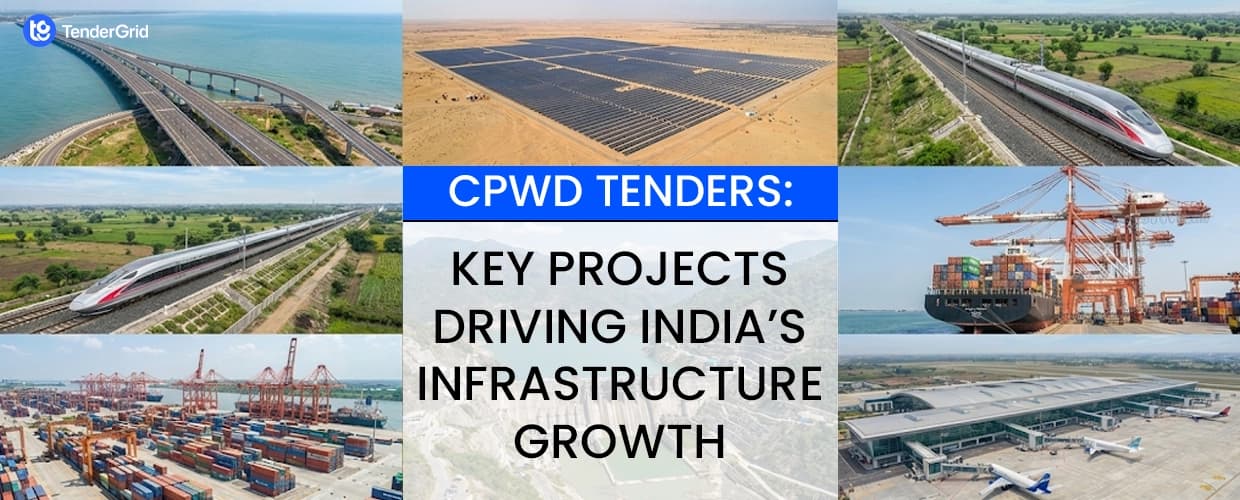
Infrastructure development in India cannot be created in one day. It is developed through the development of roads that bring together regions of a country, buildings that facilitate governance of a region or a state or a country, and healthcare and education developed through hospitals and institutions that bring together educational ideas that enable a country to grow. A number of these projects lie hidden in the CPWD.
CPWD Tenders are extremely important in helping shape a reality of national development aspirations into concrete assets. Right from landmark government structures to necessary urban developments in India, tenders from CPWD provide insight into where India is headed in the future with their construction endeavours.
CPWD works under the Ministry of Housing and Urban Affairs and is concerned with planning and execution, as well as the maintenance of public sector infrastructure in India. Unlike most state-government-run entities in India, CPWD projects are of national significance with large budgets and quality standards to be met.
However, what makes CPWD unique is that it operates across sectors, administrative buildings, residential complexes, health facilities, educational campuses, cultural centers, and major renovation projects. Thus, the Infrastructure Tenders initiated by CPWD tend to invite some of the most seasoned players available in the market.
1. Government buildings and administrative complexes
A large number of Government Tenders issued by CPWD pertain to the construction and modernization of government infrastructure for administration. These include ministries, secretariat offices, tribunals, and offices in metro and state capital cities.
While the government is promoting more efficient working spaces, projects completed more recently are now adhering to green building standards. What this means is that construction companies now have more projects to undertake, not only in construction but also in MEP, automation, and green materials.
2. Healthcare Infrastructure Projects
Hospital projects, medical college projects, research facilities, and specialized healthcare facilities constitute a major segment of the tender activity of CPWD. Since the pandemic, there has been a visible thrust towards improving public healthcare infrastructure.
Such CPWD Tenders are often complex in terms of specifications related to various aspects of HVAC. Given the permanent national priority being accorded to the health sector in most countries, this particular type of tender continues to register proper eTendering.
3. Educational and Institutional Infrastructure
CPWD is actively involved in the construction and upgrading of institutional buildings like IITs, IIMs, Central Universities, schools, and training academies. Such works not only include class rooms but also hostels, auditoria, labs, and residences.
For infrastructure companies, educational projects are less cyclical with predictable, timed delivery schedules. They also offer the potential for repeat business because many educational campuses expand over time through a series of contracts.
4. Residential Housing for Government Employees
The other type of work done by CPWD is related to residential infrastructure, which is a less-discussed but significant part of the organisation’s work. The construction of housing projects for government servants, such as large residential colonies and redevelopment schemes of older resettlement quarters, provides a constant stream of tenders.
Such projects are of special interest to contractors who specialize in mass housing, prefabrication methods, and urban renewal, especially in cities that emphasize optimizing land use.
5. Redevelopment and Heritage Projects
The CPWD is also involved in restoring and redeveloping historic buildings and iconic buildings. Such projects call for a good mix of modern demands and architectural preservation.
These types of Infrastructure Tenders require specialised knowledge and expertise that make them a perfect fit for companies that already understand the realms of restoring and retrofitting structures and construction through the medium of conservation.
CPWD projects thus act as trendsetters in terms of scale and diversity, often influencing technical standards followed by other agencies in the public sector through tendering procedures or contractual frameworks.
Moreover, CPWD Government Tenders usually come with transparent procedures, defined milestones, and relatively stable funding, reducing uncertainty for bidders. For many mid-sized and large infrastructure firms, CPWD projects form the backbone of their public-sector order books.
Given the fact that most procurements are now electronic, the CPWD has adopted the use of eTenders fully. This helps to ensure that more people get involved and that transparency is achieved. The number of tenders and the complexity involved make it difficult for one to navigate through them manually.
Successful bidders typically focus on:
Missing even a minor detail can lead to disqualification, making tender intelligence and monitoring essential.
Organising CPWD opportunities manually through various portals is quite inefficient. This is where the importance of Tender Grid comes into the picture.
Tender Grid streamlines access to CPWD Tenders, Infrastructure Tenders, and other government tenders by consolidating authentic tenders on one platform. Using intelligence filters, notifications, and industry-specific grouping, companies can find eTenders within mere minutes and not invest days searching various tender websites.
Except for the aspect of discovery, Tender Grid assists clients in analysing tender tendencies as well as understanding bidding trends to give them a proper edge.
With India pushing toward goals like urban modernization, sustainable development, and building institutional capacity in the long term, the role of CPWD will only increase. Future years are thus likely to see heightened activity on investment in green buildings, redevelopment of old infrastructure, and technologically state-of-the-art public facilities.
For contractors and consultants with the propensity to adapt, upskill, and be better informed, CPWD Tenders offer much more than projects-they provide ways to coauthor the dynamic story of India's infrastructure.
The projects undertaken by CPWD are not merely construction contracts but, in essence, an investment in the fabric of the future of this country. Be it hospitals, universities, government buildings, or residential colonies, these contracts symbolize what this country focuses on and responds to, in real terms, at any given point in time.
If the focus on being vigilant about the right opportunities and the utilization of tools such as the Tender Grid can enable businesses to transcend the process of chasing tenders, then the possibility of infrastructure development in the country becoming an opportunity for them cannot be ruled out in the least.