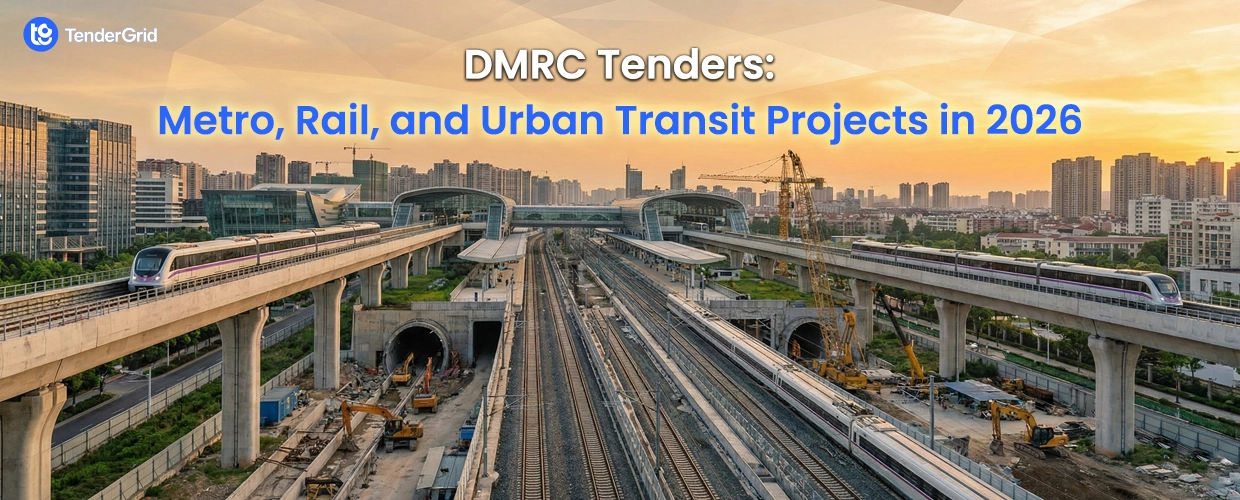
When Delhi Metro commenced its services in 2002, no one would have thought that it would become the prime architect of India’s urban evolution in the upcoming time.
What began as an ambitious mobility solution for Delhi has today become a benchmark model for metro rail execution across the country. At the heart of this is the Delhi Metro Rail Corporation, one of India’s most trusted infrastructure executors. Whether it is laying of tracks, expanding the capacity, developing new corridors, or maintaining existing tracks, the DMRC acts as a consultant, project manager, and technical advisor for metro systems across multiple Indian cities.
Today, India is urbanising at a record speed. The Indian government’s plans to expand the metro to various tier 2 cities. Phase IV of the Delhi Metro is nearing completion. The blueprints for Phase V (A) are already hitting the desks of engineers.
As a result, the number of DMRC e-tenders, metro tenders, railway tenders, urban transit project tenders, etc., is expected to increase, fuelling India’s Viksit Bharat story.
Role of DMRC Tenders in India’s Urban Growth in 2026
In the next few years, a huge portion of the Indian population will live in urban areas. This means cities need to have the proper capabilities and the required infrastructure to ensure smooth accommodation and movement of these millions of people in a predictable, affordable, and sustainable manner.
In such a scenario, DMRC tenders are not just some administrative documents; rather, they are the operational tools through which urban transformation actually happens.
At present, India is witnessing:
- Expansion of metro rail network
- Integration of urban and national mobility networks
- Development of technologically advanced metro infrastructure
Through DMRC tenders, the government can transform these plans into operational corridors that redefine urban mobility. Due to this, the role of DMRC eTenders in helping the government efficiently achieve these plans is expected to become more crucial than ever.
List of Major DMRC Tenders in 2026
At present, DMRC is working on some of the most prestigious projects to support urban economic growth. For this, DMRC has invited tenders for various works as follows:
-
Design, manufacture, and commissioning of 68 broad-gauge cars for the Rithala–Narela–Nathupur Corridor (Line 1 extension).
-
Design and construction of twin tunnels using shield tunnel boring machines for the Central Vista Corridor.
-
Engagement of a consultant for EIA-SIA for the upcoming Phase V (A) of DMRC.
-
Expression of interest for the development of an Agentic AI-based project management system (AI-PMS).
-
Maintenance contract for station buildings and viaducts on Line-3 (Yamuna Bank to New Ashok Nagar).
-
Servicing and overhauling of L&T-make ACBs for Line-2 and Line-6.
-
Refurbishment, upgradation, and modernisation of five lifts at IT Park, Shastri Park.
-
Retrofitting fibre optic-based cable differential relays in Phase I, II, and III ring main feeders.
-
Property development at the Inderlok metro station of Line 1.
-
Ground floor development at Anand Vihar Metro Station of Line-4.
-
Licensing of parking rights at Kashmere Gate (Lot 1) metro station.
Apart from these, the Indian government is planning various other development projects, bringing a significant increase in the DMRC and metro tenders.
Eligibility criteria to apply for DMRC tenders
To apply for DMRC tenders, businesses should meet the following eligibility criteria:
Registration requirements
Any business looking to apply for the DMRC tenders should have a valid registration number, PAN, and GST certificate. In addition, the company should not be blacklisted by DMRC or any other relevant authority. The company should also comply with India’s procurement norms and standards.
Financial eligibility
DMRC typically sets clear financial benchmarks to ensure that only capable firms can bid for high-value infrastructure projects. For instance, each company should have a certain minimum average annual turnover over the last few years. The business should also have a positive net worth and audited financial statements. Additionally, the company should also have working capital and access to credit lines.
Technical expertise
For every DMRC tender, bidders must demonstrate their ability to quickly deliver the undertaken metro projects within the predetermined time frame and deliverables. Businesses should have:
-
Prior experience in executing similar projects
-
Portfolio of successfully completed projects
-
Proven expertise in metro/railway-specific technologies
-
Performance certificates from previous clients
Compliance and safety
DMRC projects operate in dense urban environments, due to which safety and compliance are non-negotiable. Compliance and safety typically include:
-
ISO certifications
-
Safety management systems
-
Environmental compliance measures
-
Past safety performance records
-
Additional workforce and training certifications
How to Track DMRC and Metro Tenders in 2026?
Businesses can use the following platforms to track the latest DMRC and metro tenders in 2026:
-
Official DMRC eProcurement Portal: It is the leading source for all Delhi Metro-related tenders. This portal allows users to find the Notice Inviting Tenders, tender documents, corrigenda, eligibility criteria, etc., for the newly published tenders.
-
Central Public Procurement Portal: It is the central government’s primary portal to gain information on the high-value infrastructure-related tenders from multiple government authorities, central ministries, and public sector bodies.
-
Region-Specific Portal: These portals are great for tracking projects where DMRC acts as a consultant in other cities. These include dedicated metro portals, such as Patna Metro, Namo Bharat, Jaipur Metro, Mumbai Metro, etc.
-
E-tendering Portals: E-tendering portals, such as Tender Grid, are also getting increasingly popular among users to gain up-to-date insights into the latest DMRC tenders. Tender Grid also offers advanced features and filters to help users quickly register, find, access, download, and track the tender information in a few clicks.
Conclusion
In 2026 and beyond, the DMRC will quietly shape how Indian cities transform and function every single day. In fact, DMRC has evolved from a metro operator in Delhi to a benchmark institution responsible for boosting infrastructure momentum, long-term economic planning, and policy commitments.
At present, India is experiencing various challenges associated with rising commuter expectations, traffic congestion, population density, environmental pressure, and many more. In such a scenario, DMRC tenders are not just some procurement documents: rather, they form the backbone of India’s mobility landscape.
Whether you are a contractor, OEM, infrastructure firm, technology provider, or mobility startup, DMRC tenders represent unlimited high-value opportunities in 2026.