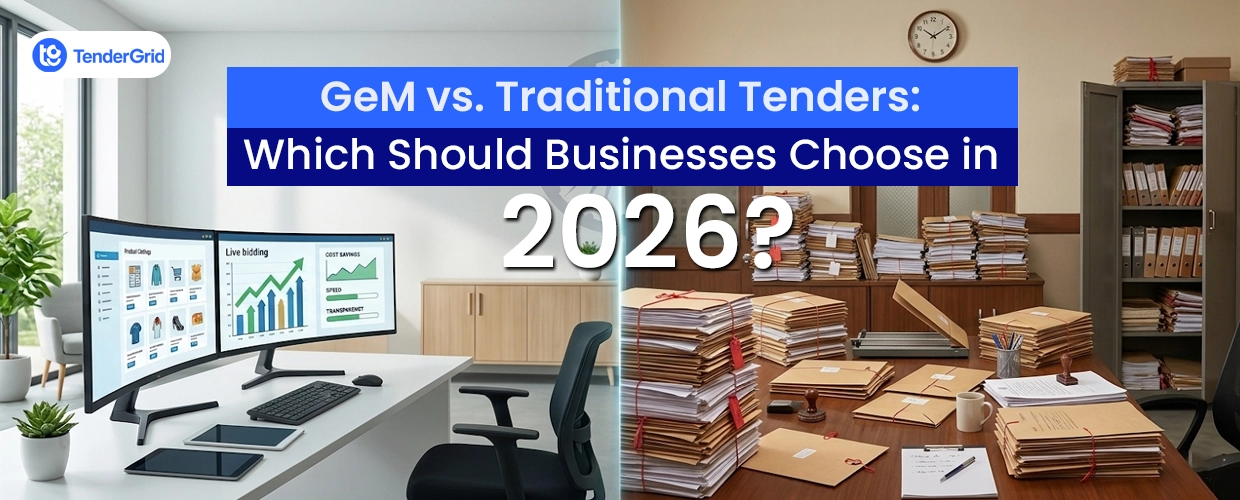
In 2026, India’s growth story is not just limited to startups, unicorns, and manufacturing exports. It is also about how the government spends. Every major development project, whether highways, railway corridors, smart cities, water supply schemes, renewable energy parks, or digital infrastructure, flows through one channel, i.e., the tender system.
At present, India’s public procurement market is massive, with experts estimating that lakhs of crores are spent annually across ministries, PSUs, defence establishments, state governments, and municipal bodies.
Over the last decade, the focus of the government on rapid digitisation, corruption reduction, increasing MSME participation, etc., has led to a significant shift in the tendering landscape. Manual submissions have faded. Online bidding is now standard practice. Transparency norms have tightened. Audit trails have become digital.
In fact, the government of India launched GeM (Government eMarketplace) to simplify public procurement in India. For many small businesses, it opened doors that were previously difficult to access. Businesses are no longer interested in traditional tenders; rather, they focus on GeM tenders to quickly find and bid for their preferred tenders.
This blog tries to shed some light on the GeM and traditional tendering landscape, the benefits of GeM, challenges of traditional tendering, digital procurement vs traditional procurement, and many more relevant concepts.
What is GeM?
Launched in 2016, GeM is India’s official public procurement portal for contactless, transparent procurement of various goods and services required by government ministries, departments, and PSUs.
Since its launch, the sole aim of this portal has been to replace the paper-based, traditional tender system with a faster and digital marketplace.
From being a basic platform for procuring basic products to handling complex service contracts and bidding formats, it has come a long way.
In 2025–26 alone, GeM crossed record procurement volumes worth several lakh crores annually. Over the last few years, it has onboarded millions of sellers, including MSMEs and startups. GeM portal tenders are becoming increasingly popular over traditional tenders due to the flexibility they bring.
How Does GeM Work?
At the GeM portal, everything, from bidding to payment, happens online. Businesses that are interested in selling their products or services need to register themselves on the portal to list their products and services. Whenever buyers need to procure something, they only need to log in to the portal to search for their preferred tenders. Once a tender is identified, they can initiate bidding or purchase directly within prescribed limits.
This system typically includes:
- Direct Purchase (for lower-value procurement)
- L1-based bidding
- Reverse auction mechanism
- Service procurement modules
- Vendor rating and performance tracking
- Online invoice and payment tracking
Benefits of GeM Over Traditional Tendering for Businesses
The GeM portal offers various benefits over traditional tendering for businesses, as follows:
- Improved transparency
- Reduced human intervention
- Standardised pricing
- Supports MSME participation
- Rapid procurement cycles (in weeks)
- Less corruption and leakage
Who Can Sell on the GeM Portal?
In 2026, any businesses with proper registration, PAN, GST, Aadhaar, and bank documents can sell on the GeM portal. The following types of businesses actively deal in GeM tenders by selling on the GeM portal:
- MSMEs
- Startups
- Manufacturers
- Traders
- Service providers
- OEMs
What is Covered Under GeM Tenders?
GeM tenders typically cover procurement of:
- Vehicles
- Office supplies
- Industrial tools
- IT hardware and software
- Consultancy services
- Security and manpower services
- Facility management
- Construction-related projects
Apart from these, Government eMarketplace tenders also cover various other procurement, operation, and maintenance activities depending upon the project requirements.
What is Traditional Tendering?
Traditional tendering is the conventional method of procurement in which organisations rely on paper-based documents to invite bids and release tenders.
Earlier, it used to be the standard process to procure required goods and services. However, things changed after the launch of eProcurement portals such as GeM and CPPP.
From specification documents to bid proposals, everything happened through hard copies and manual methods.
How Does Traditional Tendering Work?
Unlike marketplace-based buying, the traditional tendering system follows a structured, project-driven process with strict technical and financial evaluation.
In the traditional tendering process, whenever a government department needs to procure something, it needs to identify the project requirements and create a detailed tender document. In the document, information on the technical specifications, scope of work, eligibility criteria, financial conditions, timelines, etc., is mentioned.
Once the document is prepared, it is floated by the authorities. Interested buyers can download the tender documents and submit hard copies of:
- Technical bid
- Financial bid
- Earnest Money Deposit (EMD)
- Proof of past experience
- Turnover and solvency documents
- Compliance certificates
After this, authorities manually review the technical bid first. If it qualifies the eligibility criteria, then the financial evaluation is done.
Which Types of Projects Use Traditional Tendering?
The traditional tendering is used by the government organisations and departments to procure things that involve high contract values and long execution timelines. These include:
- Infrastructure projects
- EPC contracts
- Railway works
- Power transmission projects
- Defence contracts
- Urban development works
- Large consultancy assignments
Challenges of Traditional Tendering and Procurement
Some of the challenges of traditional tendering and procurement are as follows:
- Lengthy and complex documentation
- Long evaluation and award timelines
- High entry barriers
- Working capital
- High administrative costs
- Risk of disqualification on technical backgrounds
- Intense competition
- Slower dispute resolution
GeM vs Traditional Tenders (2026 Comparison)
1. Which Has a Heavier Documentation Requirement?
Traditional tenders have heavier documentation requirements as compared to GeM tenders. In GeM tenders, specifications are predefined within the platform framework. Whereas in traditional tenders, detailed compliance and error-free documents for declarations, financial bids, technical bids, etc., are required. One small error can lead to disqualification in traditional tenders.
2. Which Tendering Model is Faster?
The GeM tendering process is faster when compared to the traditional tendering process due to automated workflows and standardised processes.
3. Which Model is Better for MSMEs and Startups?
GeM tenders typically offer lower entry barriers, making them perfect for MSMEs and startups. These tenders do not require extensive project history and follow a simplified structure that encourages wider participation.
Whereas traditional tenders often require minimum turnover and past similar project experience, making it difficult for the MSMEs and startups to independently participate in these unless they form joint ventures or act as subcontractors.
4. Which Procurement Model Supports High-Value Infrastructure Projects?
Traditional tenders support high-value infrastructure projects. These include projects associated with railway, highway, power, urban development, etc.
How Can Tender Grid Help MSMEs Succeed on Both Platforms?
At the present time, any tender, whether a GeM listing or a traditional one, moves quickly. Categories update frequently, reverse auctions have tight deadlines, and tenders are scattered across multiple websites and portals. In such a scenario, missing the right opportunity by a few hours can significantly cost MSMEs. In addition, manual monitoring of different portals and websites is also not feasible due to time and resource constraints.
To prevent such challenges and optimally track the latest GeM and traditional tenders, MSMEs can use Tender Grid.
Through this portal, MSMEs can filter the tenders based on product category, department, location, bid value, and submission timeline. Additionally, they can set alerts for their preferred tenders to never miss an update.
Through Tender Grid, businesses get structured discovery of all the relevant tenders in one place, eliminating the need to manually check the GeM portal multiple times a day. This is highly beneficial in reducing the search time and increasing participation consistency.
Conclusion
At present, India’s public procurement ecosystem is no longer about GeM or traditional tenders. Both of these types of tenders have their own benefits. While GeM tenders are great for standardised goods and services, traditional tenders dominate high-value contracts with long-term growth.
For MSMEs, GeM tenders offer better speed and visibility, meaning they offer faster entry and manageable compliance. If you are a contractor or established business, traditional tenders offer high-value, complex projects.
Certain businesses also follow a hybrid approach in which they target GeM tenders for steady revenue flow and traditional tenders for scale and expansion.
Choosing the right tendering route is no longer an operational decision. It is a growth decision.