In the present decade, India’s maritime sector is expanding fast.
Due to rising exports, coastal shipping demand, naval modernization, and policy pushes like port-led development, it is no longer limited to ports and cargo movement.
The scale has become bigger, driving a parallel surge in marine and shipbuilding infrastructure. The goal of the government is clear: rapidly expand the country’s marine and shipbuilding capabilities.
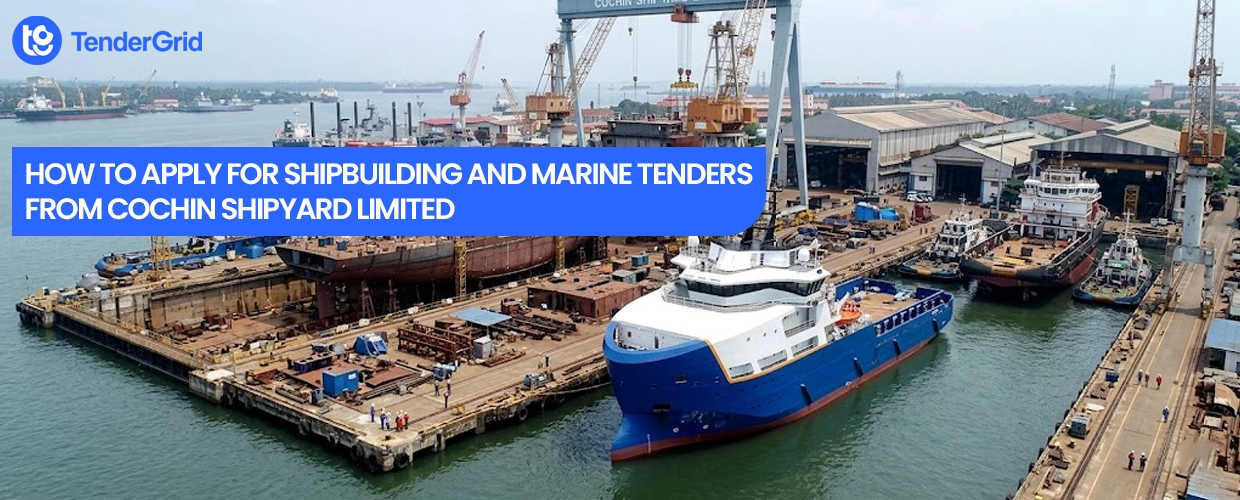
Cochin Shipyard Limited plays a central role in this expansion, which is responsible for building and upgrading maritime infrastructure in India. The company regularly floats shipbuilding tenders, marine infrastructure tenders, and shipyard construction tenders to carry out its activities. These tenders cover everything associated with defense vessels, commercial shipbuilding, repair ecosystems, and large-scale shipyard construction.
These tenders follow a defined eProcurement flow, strict eligibility filters, and layered evaluation. Businesses cannot guess their way through it; rather, they need to understand the whole process in order to easily apply to shipbuilding and marine tenders from CSL.
This blog is of utmost help for businesses looking to properly understand the application and bidding process.
How Does CSL eTenders Support India’s Shipbuilding and Maritime Industry?
Cochin Shipyard Limited eTenders play a critical role in India’s shipbuilding and maritime industry because they convert the government-backed maritime projects into structured bidding opportunities. These tenders directly enable vessel construction, shipyard expansion, repair, and technology partnerships aligned with national maritime goals.
In addition, the company is working on some of the biggest shipbuilding projects, such as the construction of anti-submarine warfare shallow water crafts, the delivery of advanced naval vessels, the development of multi-purpose cargo ships, etc.
Each of these projects requires fabrication, outfitting, electrical systems, marine equipment, subcontracting, and various other works. CSL eTenders are used to procure these components. Furthermore, CSL tenders are tied directly to national programs like Atmanirbhar Bharat, Maritime India Vision 2030, green shipping initiatives, etc., to expand the shipyard and marine infrastructure capacity.
Apart from these, CSL has an order book of over ₹21,000 crore and a future pipeline estimated at ₹2.85 lakh crore. To deliver these orders, Cochin Shipyard Limited relies on tenders, which turn policy into real opportunities.
Different Types of Shipbuilding Tenders From Cochin Shipyard Limited
At the present time, CSL is working on various projects, including vessel construction, modular fabrication, outfitting systems, marine equipment supply, testing, and repair integration. For this, it regularly releases tenders at multiple levels for the following works:
- Hull fabrication
- Structural shipbuilding
- Modular construction
- Marine equipment supply
- Electrical and automation system
- Outfitting
- Testing and commissioning
- Repairing and retrofitting
- Specialized defense shipbuilding
- Hybrid vessel
- Subcontracting
How to Apply for Cochin Shipyard Limited Tenders?
The Cochin Shipyard Limited follows a very strict eProcurement process to ensure the selection of only reliable vendors. This means a small marginal error can lead to instant dismissal of the application. Therefore, businesses should focus on the following step-by-step process to properly apply for CSL tenders in 2026:
1. Complete Vendor Registration
This is the first step in which vendors are required to register on the official CSL supplier management system. During registration, they also need to select the most appropriate product/service category for their business. Also, they need to upload relevant business documents, such as the incorporation certificate, PAN, GST, etc.
2. Get a Class 3 Digital Signature Certificate
A DSC certificate is required to log in to eProcurement portals, digitally sign the tender documents, and submit the final bids. It acts as a business identity in the eProcurement system; hence, it needs to be installed and tested before submission. If the DSC doesn’t work, it may lead to bid failure even if only 10 minutes remain until the deadline.
3. Identify Relevant CSL Shipbuilding and Marine Tenders
After the registration and DSC parts, the next step is to identify the most relevant CSL shipbuilding and marine tenders. For this, they can use the CSL official website, GeM, CPPP, Tender Grid, etc. These portals are great for tracking ongoing and upcoming tenders. This is useful for businesses in proactively preparing the bids to ensure greater chances of success.
4. Read the Tender Document Carefully
It is one of the most important steps where most bidders go wrong. They casually go through the tender documents instead of carefully reading them. This often leads to the creation of numerous confusions associated with the scope of work, eligibility criteria, BOQ, bid submission format, project-specific clauses, etc.
What they need to do is extract the exact qualification thresholds, mandatory and optional requirements, and deviation rules to identify any potential problems.
5. Prepare a Strong Technical Bid
The next step is to prepare a strong technical bid. Technical bids for shipbuilding and maritime tenders often require the vendors to provide complete technical information about their firm. These typically include a complete company profile, past project credentials, methodology, resource capabilities, etc. Bids with generic content are rejected instantly, so it is advisable to properly prepare the technical bids with all the required details.
6. Build a Smart Financial Bid
Similar to the technical bid, the financial bid also needs to be carefully developed. Yes, L1 matters in CSL tenders, but blindly going lower is risky. This is because unrealistic bids, price mismatches between BOQ and summary, and ignored extra costs can lead to rejection. Vendors should carefully decide the overall costs and pricing depending upon various factors instead of targeting the L1 bidding.
7. Arrange EMD, Tender Fees, and Compliance Documents
After the bid preparation, the vendors need to submit the EMD, tender fees, affidavits, and declaration documents. One thing to remember is that the EMD format, issuing bank, and validity must match exactly as per the tender. Any mismatch can result in straight rejection.
8. Submit the Bid on the eProcurement Portal
In this step, the prepared technical and financial bids are submitted on the official eProcurement portals. Vendors need to upload technical documents in the correct folders, upload financial bids separately (as per system structure), and digitally sign all required files.
Avoid situations like uploading wrong file formats, waiting till the last moment, and submitting financial data to the technical section.
9. Track Bid Evaluation and Clarifications
After submission, CSL first evaluates the technical bid. If the technical bid is shortlisted, then the financial bid of the vendor is evaluated. During this evaluation, businesses can receive clarification requests, demands for additional documents, deviation queries, etc. Delayed or incomplete responses in such a scenario mean silent rejection. So, tracking the bid evaluation process is also a critical step.
How Tender Grid Helps Find Active Cochin Shipyard Limited Tenders in 2026?
In 2026, Tender Grid is one of the top portals to find and track the active CSL tenders and shipbuilding tenders. This is because the platform offers:
- Aggregated listings from CSL, CPPP, and GeM into a single dashboard
- Real-time alerts
- Advanced search filters
- Sector-specific tracking for shipbuilding and marine projects
- Early visibility into upcoming opportunities
- Simplified tender management and tracking
Through these, vendors can reduce the risk of missed deadlines or opportunities, enabling better growth.
How to Improve the Success Rate in CSL Tender Applications?
Businesses can improve the success rate in CSL tender applications by using the following practices:
- Treat every CSL tender as a high-value opportunity
- Build sector-specific credibility in shipbuilding and marine projects
- Master the tender document through comprehensive reading and understanding
- Prepare a strong, evidence-backed technical bid
- Develop a smart pricing strategy
- Eliminate compliance errors completely
- Do not wait for the last moment; submit the bid early
- Build OEM and technical partnerships
- Prepare a repeatable bidding system to learn from lost bids
Through these practices, businesses can significantly reduce the chances of rejection and ensure their bids are aligned with shipbuilding and marine tenders.
Conclusion
In 2026, India’s marine sector is not slowing down. The sector is getting more competitive and far more structured. Shipbuilding and maritime projects are increasing throughout India. In such a scenario, shipbuilding tenders, marine infrastructure tenders, and shipyard construction tenders are shaping the next phase of maritime growth.
These CSL tenders are not just about winning a contract. They are about entering a system that delivers long-term projects, repeat business, and a strong position in India’s shipbuilding ecosystem.
This means that CSL tenders are not one-off opportunities in which a vendor submits the bid and waits for the results. Instead, they need to understand the tender documents, prepare technical bids properly, set pricing smartly, and avoid any compliance errors in order to effectively win the tenders.