© 2022-2026, Tender Grid, All rights reserved.

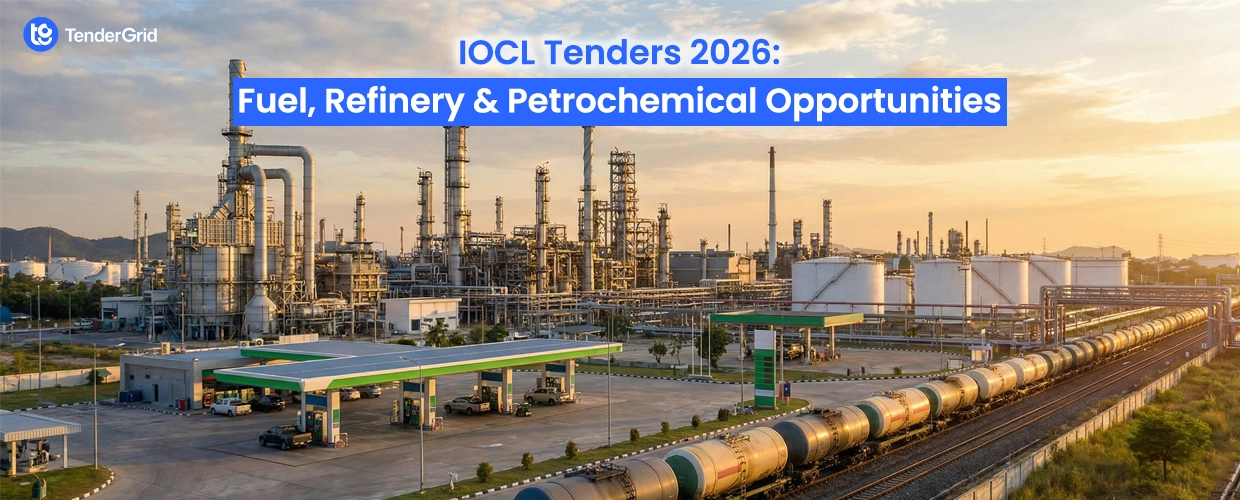
In 2026, India’s oil and energy landscape is transforming at a pace very few could have predicted years ago. Factors such as growing internal demand, a high need for energy security, a surging economy, an expanding middle class, etc., are driving this transformation. At the heart of this transformation are IOCL tenders, fuel tenders, refinery tenders, and petrochemical tenders that help India meet its fuel needs.
This means that 2026 presents enormous growth opportunities for businesses dealing in the Indian Oil Corporation eTender process, allowing them to stay ahead of the competition and actively contribute to the nation’s economic growth.
At present, the aim of the Indian government is clear: reduce import dependence and meet the surging demand.
Also, the Indian Oil Corporation has set a goal to invest ₹ 1.66 lakh crore in fuel, refineries, and petrochemicals over the next few years.
The demand for fuel, refinery products, and petrochemicals is surging, due to which these initiatives will eventually lead to an immense rise in the IOCL tenders.
In 2026, IOCL is hugely focused on:
Modification of existing refineries
Emission-compliant upgrades
Residue upgradation units
Petrochemical integration projects
As a result, IOCL tenders will play a major role in helping the country meet its fuel demand, due to which they matter more than ever.
Whenever a new IOCL tender is released, it means new opportunities in the form of supply chains, technology upgrades, capital flows, and even regional industrial growth, generating new tenders.
Earlier, fuel tenders were mostly associated with petrol and diesel. However, with the increasing demand and consumption, they also cover ethanol, green hydrogen, CBG, EV infrastructure, etc. In such a scenario, the need to develop and maintain proper infrastructure for different types of fuels is critical to ensure constant supply.
In addition, the Indian government is highly focused on its Ethanol Blending Programme and SATAT scheme to meet its energy demand, bringing numerous opportunities for businesses involved in fuel tenders.
Fuel tenders in 2026 include the following:
The Indian Oil Corporation’s plan to expand its processing capacity to 98.4 MMTPA by 2028 is rapidly making progress. In addition, technology upgrades and government priorities like energy security and import substitution are also leading to an increase in refinery modernisation and expansion projects, such as the Panipat refinery capacity expansion, Gujarat refinery capacity upgrade, and Barauni refinery expansion.
As a result, businesses can expect constant growth in the refinery tenders, EPC contracts, equipment supply bids, digital procurement opportunities, etc. Some of the leading refinery tenders in 2026 are as follows:
Apart from these, 2026 may witness various other refinery tenders for maintenance and reliability services, quality control systems, pyrolysis and cracker units, storage and material handling systems, civil works, auxiliary facility expansion, etc.
In the upcoming time, IOCL is expecting to make significant progress in petrochemical procurement and supply. For this, it needs to upgrade existing refineries and infrastructure to support the production of petrochemical products. It is a massive window of opportunities for businesses looking to invest in the tenders for infrastructure expansion, refinery-petrochemical integration projects, high-value chemical manufacturing, etc.
Additionally, projects like the Paradip Petrochemical Complex and Gujarat Refinery LuPech are also in progress to develop and meet India’s petrochemical capacity. Due to this, an increase in the petrochemical tenders will be noticed in the upcoming time.
Below are the leading petrochemical tenders in 2026:
Rate contract for procurement of liquid isobutane for the IOCL, Panipat.
Refurbishment of the ID fan rotor for the NCU heater at IOCL Panipat Naphtha Cracker Plant.
Third-party inspection agency for supervision during sampling and weighing activities and assay of platinum-based CCRU spent catalyst of Paradip Refinery, Paradip, Odisha.
Supply & delivery of consumable materials (power cable) for composite works (WP-10) for the Lupech (J-18) Project at IOCL Gujarat.
Rate contract for procurement of stearic acid for the PBR project at the PRPC complex of IOCL, Panipat.
Repair of coke drums in the DCU unit at the Panipat refinery.
Rate contract for operation, maintenance, and performance monitoring of the N₂O₂ unit under the LuPech project.
Businesses having prior experience in the fuel, refinery, and petrochemical projects can participate in the IOCL tenders. These include proprietorship firms, LLPs, private/public limited companies, MSMEs, startups, etc. However, they should meet certain predetermined criteria to become eligible for IOCL tenders in 2026. Some of the requirements are as follows:
DSC, PAN, and GST registration certificates
A certain value of turnover in the last three preceding financial years
Portfolio of successfully delivered relevant projects
Compliance with labour laws and industry standards
Technical manpower capability
Safety compliance documentation
Interested businesses can either use government e-tender platforms, such as GeM, the official IOC e-tender portal, and the Central Public Procurement Portal or e-tendering portals like Tender Grid to track, find, and access the latest IOCL tenders, their bidding information, and deadlines.
In 2026, India is shifting from traditional oil refining to integrated petrochemical hubs and green energy clusters. From the nationwide rollout of ethanol and EV infrastructure to high-stakes expansion in refineries, the Indian government is looking towards IOCL to align its procurement ecosystem directly with the government’s goals. This will open up a massive number of tenders in IOCL, fuel, petrochemical, refinery, etc., bringing opportunities at scale for vendors.
Businesses need to make IOCL tenders a core part of their business roadmap if they want to contribute to India’s energy growth story.