© 2022-2026, Tender Grid, All rights reserved.


Each year, state, local, and central governments carry out millions of transactions in public sector procurement, with most contracts awarded to competitive contractors. Given this, it's clear how essential a strong tender pricing strategy is for winning government tenders. In this blog, we will discuss the importance of pricing your bid competitively and explore additional methods to strengthen your bidding decisions in your favor.
The procurement of services or products is aimed at getting competitive bids and selecting the one that best meets the investor’s requirements. These bids can be analyzed based on various criteria, but the main factor among them is typically the total price.
The Low Bid (LB) model is a common approach in this case used to treat the bid with the lowest price and is the most advantageous for the client. This model works well for straightforward projects with clear designs and specifications, as price is the main differentiator, especially when timelines and payment terms are set.
Alternatively, the Best Value (BV) model considers not only price but also factors like quality, long-term costs, and environmental impact. While this approach gives a more complete view of value, it requires more effort to set up and evaluate multiple criteria to choose the best overall option.
Now, let’s examine the general pricing components that competitive contractors consider while planning their bid pricing.
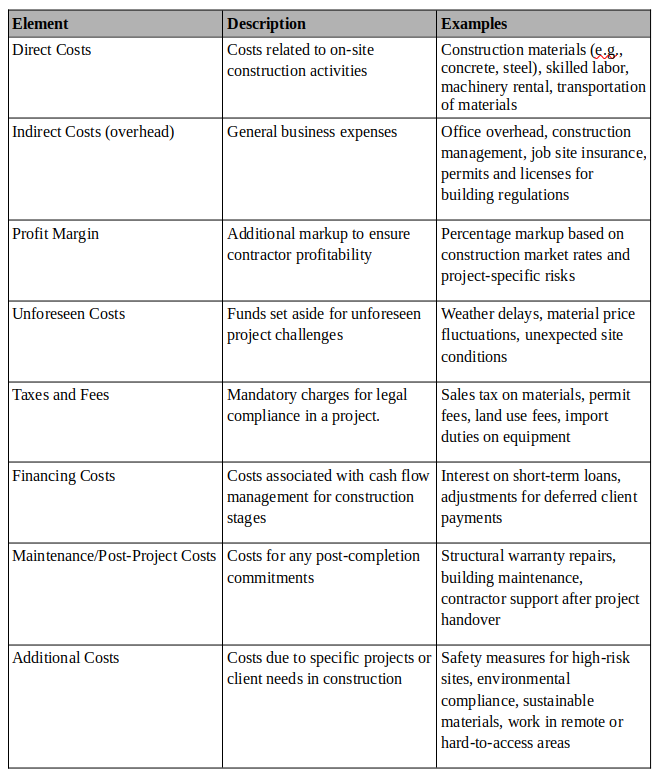
Let's now understand how these bid pricing components are used in real-world tender evaluation methods.
The Most Economically Advantageous Tender (MEAT) method evaluates tender bids based on a balance of price and quality. For example:
(1) When focusing on the quality, the price-quality weightage will be 70% quality and 30% price. This will emphasize quality-driven pricing elements like skilled labor, durable materials, or sustainable practices.
(2) When the focus shifts to price, the weightage will be 60% price and 40% quality. In this case, contractors prioritize pricing elements that are more cost-efficient such as using economical materials and minimizing indirect costs.
Adjusting the focus of your bid based on these weightings can maximize your bid’s score potential.
Apart from the MEAT ( Most Economically Advantageous Tender ) evaluation method, there are many others used by government organizations. Some of them are:
(1) Two-Envelope Evaluation Method
(2) Weighted Scoring Evaluation Method
By adopting a comprehensive approach to tender pricing, contractors can confidently submit bids that are competitive without sacrificing profit.
Regularly gain insight into your competing bidders to improve your tender pricing strategy and its accuracy. Start by identifying your key competitors to anticipate their bidding approach, assess their strengths and weaknesses, and the typical pricing structures they follow. Similarly, you can highlight the unique advantages in your bid like high quality or cost efficiency. By anticipating your competitor’s approaches, you can well position your bid and increase the chances of winning government tenders.
Setting a competitive price for a tender while ensuring profitability calls for a strategic combination of precision, clarity, and flexibility. By carefully examining both direct and indirect expenses, predicting market changes, and grasping client evaluation criteria, contractors can develop proposals that shine in terms of value and dependability.
Ultimately, a well-informed strategy for tender pricing increases your likelihood of success, and resources like Tender Grid can facilitate the process, offering essential assistance in creating bids that are competitive and financially sound.