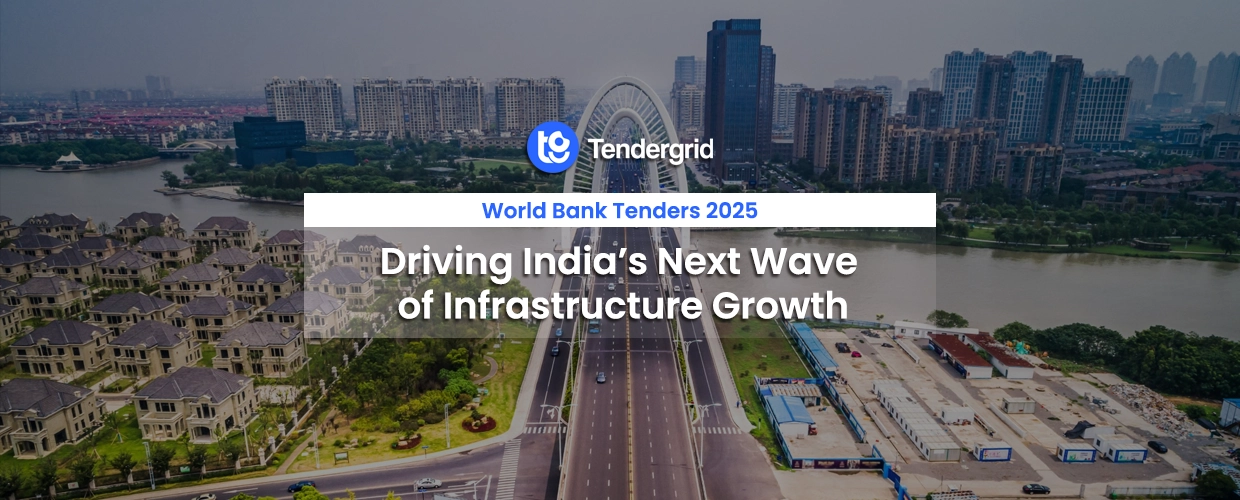
India is on a remarkable footing, as its development is now somewhere related to the international cooperation. While partnering with the World Bank, India’s economy is rapidly growing with the vision of sustainable infrastructure, urban renewal, and digital connectivity.
In 2025, the World Bank tenders are not just about the procurement of high-value projects, but they are highly responsible for India's future growth cycle. Projects that are supported by the World Bank are responsible for developing the latest infrastructure, including cutting-edge transport corridors to climate-resilient cities.
The Power of Global Funding Meets Local Growth
The World Bank is one of the most important development bank partners that is responsible for the development of India’s infrastructure. The financial and technical support provided by the bank helps in initiating numerous projects in various sectors, including rural water supply, metro systems, and many more. But 2025 is a year of strategic transition. The emphasis is not just on development anymore but on sustainable modernisation.
This change can be seen in the new generation of Funding Agencies' Tenders being floated throughout the country. From renewable energy parks in Rajasthan and smart city logistics in Pune to climate-resilient roads in Assam, these initiatives have a higher correspondence between international standards and India's local requirements.
Through World Bank Tenders, the country not only receives access to capital but also to innovation, transparency, and world-class execution practices, a mix that underpins both governance and growth.
World Bank Tenders 2025: The Sectors in Motion
The World Bank's India portfolio in 2025 cuts across a vibrant range of sectors. These tenders are responsible for infrastructure development, which is broadly characterised into four areas:
1. Transport and Connectivity: For India’s growth, sectors including roads, highways, and railways play a major role. World Bank-financed tenders related to transport projects are now putting focus on green infrastructure, EV charging systems, and smart monitoring systems for road safety.
2. Urban Development and Housing: In order to transform urban areas into climate-resilient cities, the World Bank is initiating such projects. The aim towards initiating such Going from solid waste management to water supply and flood protection systems, these tenders are transforming how India constructs its cities.
3. Renewable Energy and Climate Action: India is working towards climate action in 2025. This will, in turn, lead to the World Bank Tenders for large-scale solar projects, energy-efficient building initiatives, and climate-resilient farm practices. These projects will reduce emissions and give rise to sustainable infrastructure.
4. Digital and Governance Transformation: The development agenda of the future rests on smart data and open systems. Digital governance, e-procurement, and IT infrastructure projects sponsored by international agencies are facilitating India's reform of how it constructs, purchases, and governs.
Tender Grid: Powering Access to Global Opportunities
Whereas World Bank projects attract foreign funding, Tender Grid is one of the ways in which Indian companies, from giant contractors to specialised consultancies, are able to locate and take part in them.
Tender Grid acts as a link between funding agencies and local participants, aggregating thousands of Government Tenders and Funding Agencies Tenders in one location. For companies looking to enter World Bank Tenders, this platform makes it easy what was once a complex, disjointed process.
No matter what your industry, whether a consultancy for environmental studies, an IT services company, or a civil engineering consultancy, Tender Grid identifies the appropriate opportunities by funding agency, sector, and geography, making global competition local.
How World Bank Tenders Are Transforming India’s Procurement Ecosystem
Aside from constructing highways and water pipes, these tenders are changing the way India buys.
Here's how:
- Transparency First: All World Bank Tenders are governed by stringent procurement and assessment standards, promoting transparent competition and minimising corruption potential.
- Capacity Building: The focus on knowledge transfer implies that Indian companies and government institutions acquire international best practices in managing projects and being sustainable.
- Innovation and Inclusivity: There is an increasing call for MSMEs and startups to engage in niche segments — from digital solutions to design innovation.
- Sustainability: Nowadays, tenders are being released that include a climate-resilient approach. Under such projects, eco-friendly infrastructure is developed with a futuristic approach.
These approaches are highly responsible for transforming India's tendering system, as long-term efficiency at a comparatively lower cost is achieved by following these.
India’s Path Forward: A Partnership-Driven Future
The influence of World Bank Tenders extends far beyond concrete infrastructure. India’s indulgence in these tenders leads to the fact that the development of India is not merely a sole mission but involves support from international funding agencies.
For significant economic growth, India is collaborating with various international institutions such as the World Bank and the Asian Development Bank. These development banks are highly responsible for providing support for the sustainable and inclusive growth of the nation.
Tenders released under funding agency initiatives lead towards development through projects related to linking villages, transforming cities, safeguarding resources, and bringing improvement to the communities.
Conclusion
2025 is turning out to be a defining year in India's growth narrative. With World Bank Tenders spurring key infrastructure projects and portals like Tender Grid enabling access to them, India's growth tale is walking into the epoch of cooperation, capability, and faith.
Where international capital converges with local know-how, each Government Tender is a move towards wiser cities, cleaner energy, and more resilient communities. The building block of India's next infrastructure wave is being laid today, one open, competitive, and visionary tender at a time.